Finding Your Fit: Why Your Shoe Size Is Only the Beginning

Finding Your Fit: Why Your Shoe Size Is Only the Beginning
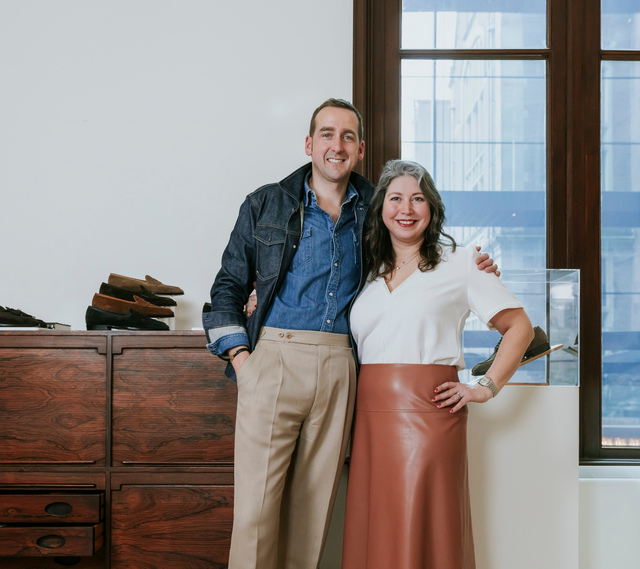
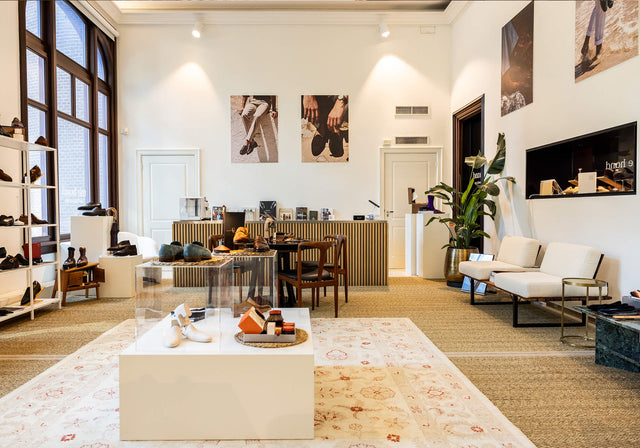
An insight into the fitting room at The Hand.
"Fit comes first."
It is something Dennis often says in our Amsterdam boutique. After all, even the most beautifully crafted pair of shoes is of little use if it spends most of its life in your closet.
One of the questions we hear most often, both in our boutique and from clients around the world, is surprisingly simple: I wear this size in one shoemaker. What size should I order in another?
You might expect a straightforward answer. Perhaps half a size up, half a size down, or a simple conversion between British and American sizing. In practice, finding the right fit involves considerably more. It starts with understanding the shoes you already own, how they feel on your feet, and what you expect from your next pair.
The Shoe We Start With
For many first fittings, Dennis reaches for an unlined Edward Green on the 202 last, often a Dover. There is a reason for this particular choice: the 202 offers balanced proportions, both visually and in the way it accommodates the foot. It gives us a useful reference from which to explore other lasts and shoemakers.
But the first question is rarely about size. Instead, Dennis wants to understand where you are coming from. Are these your first handcrafted shoes, or do you already own several pairs from different makers? What are you currently wearing? Do you appreciate a close fit, or do you prefer a little more room?
The answers help us establish a starting point. Once we understand how your foot fits into our reference shoe, we can begin exploring the differences between makers.

Same Size. Different Feeling.
Every shoemaker approaches the construction of a last differently. The last is the three-dimensional form around which a shoe is built, and it determines far more than the silhouette. Its proportions influence how the shoe supports your heel, accommodates your forefoot and fits around your instep.
Consider Edward Green and Saint Crispin's. A client who comfortably wears an Edward Green in size 9 may well take the same size in Saint Crispin's. Yet the two shoes can feel noticeably different: where the Edward Green 202 provides a balanced reference, the Saint Crispin's Classic offers a more tailored sensation, with additional grip and support.
The numbers are identical. The experience is not.
With Gaziano & Girling, we generally begin half a size above our Edward Green reference. John Lobb, meanwhile, may fit in the same size or half a size smaller, depending on the model and your foot shape. These are useful starting points, but they never tell the entire story.
For a detailed comparison of our shoemakers, reference lasts and usual starting sizes, explore our Fit Guide.
Looks Can Be Deceiving
One of the clearest examples of the difference between appearance and fit comes from Maison Corthay. Its elongated silhouettes appear remarkably slim. Looking at the shoe, you might reasonably expect a narrow fit.
Corthay also surprises in another way: this Parisian house uses American sizing. The number is half a size higher than British sizing, but the fit is the same. A UK 9 becomes a US 9½, just as it does at Alden.
Yet the real surprise comes when you try one on. Once your foot passes through the opening, the shoe often feels spacious. Corthay achieves its elegant appearance without compromising internal volume, and its relatively light construction and supple materials can provide a comfortable sensation from the first wear.
There is, however, an important consideration. The opening itself is relatively narrow. For someone with a high instep, getting into the shoe can be difficult, even when the internal volume is sufficient. Simply choosing a larger size may solve one problem while creating another: once inside, your foot may no longer receive the support it needs.
Sometimes our advice is therefore to explore a different maker altogether. It is a good illustration of why we consider the shape of your foot rather than relying on your usual shoe size.

Why Loafers Require Particular Attention
A well-fitting loafer presents its own challenge. Unlike a lace-up shoe, it has no laces to secure your foot, so grip must come primarily from the heel and instep. For that reason, many clients choose half a size smaller in a loafer than in a lace-up, as long as the length still works.
Consider the John Lobb Pace. Its exceptionally soft suede relaxes with wear. Based on our fitting experience, we generally recommend a closer initial fit, often half a size smaller than your usual John Lobb reference. A pair that initially feels comfortably spacious may eventually become too loose.
The Edward Green Polperro illustrates a different consideration. Clients with slimmer feet can often keep their regular Edward Green size, while a higher instep or fuller forefoot may require additional room.
Neither recommendation can be reduced to a universal rule. Even within the same shoemaker, the model, last, leather and construction can influence the size we recommend.

When Going Wider Is Not the Answer
Another question we regularly encounter concerns width. If a shoe feels tight around the forefoot, choosing a wider fitting seems like the obvious solution. But increasing width generally adds volume throughout the shoe, including around the heel.
For someone with a relatively narrow heel and broader forefoot, this can create an unexpected problem. The heel begins to slip. The foot moves forward. Despite the additional width, the shoe may still feel uncomfortable.
The real challenge is finding the right balance between forefoot comfort and heel support. This is where the craftsmanship behind a carefully developed last becomes visible: a well-shaped last provides room around the ball of the foot while maintaining a supportive fit around the heel and waist. Depending on your foot shape, you may discover that a standard width offers sufficient room without compromising support.
For more specific requirements, Made-to-Order can offer additional possibilities. Depending on the shoemaker, adjustments can provide more room around the forefoot while keeping the heel secure. It is not simply about making the shoe wider. It is about understanding where you actually need the additional space.
The Size You Thought You Were
Sometimes the most revealing discovery during a fitting is that a client's familiar shoe size was never quite right in the first place.
Recently, a client shared an observation after purchasing his first John Lobb City II. Now that he was wearing a shoe that properly supported his foot, he realized that many of the shoes he had bought before had been too large. He had simply become accustomed to the additional room.
It is something we occasionally encounter when fitting new clients. A shoe that feels pleasantly spacious during a brief fitting does not necessarily offer the best support throughout the day. This is why we ask more than which size you currently wear. We also want to know how your existing shoes feel. Does your heel stay secure? Is there enough room around your forefoot? Do you notice unwanted movement when walking?
Sometimes, finding the right fit begins by reconsidering the size you thought you were.
Should a Fine Shoe Need Breaking In?
Traditional shoemaking and comfort are not mutually exclusive. A Goodyear-welted shoe may initially feel firm. As you wear it, the leather becomes more flexible, while the cork filling gradually adapts to the shape of your foot.
Some constructions take more time than others. Traditional British shoes may initially feel firmer, while lighter constructions can offer greater flexibility from the first wear.
But there is an important distinction between a shoe adapting to your foot and expecting an incorrectly fitted shoe to become comfortable. Breaking in should improve an already comfortable fit, not compensate for choosing the wrong size. Our aim is always to find the balance between immediate comfort and lasting support.
Your First Pair Is Just the Beginning
Finding the right fit is not a one-time exercise. Every pair you wear teaches us something about your preferences, your foot shape and the way you experience different lasts.
Your first purchase establishes a reference. "Every pair, and especially the first, becomes the blueprint for everything that follows," says Dennis. Your feedback helps us refine our understanding, allowing us to make increasingly informed recommendations as your collection grows.
And you do not need to visit our Amsterdam boutique to benefit from that experience. For clients ordering internationally, we begin with the shoes they already own. Knowing the maker, model, size and how those shoes fit gives us a valuable starting point. When necessary, photographs or a short video consultation help us refine our advice.
Whether we are welcoming you into our boutique or helping you discover a new shoemaker from the other side of the world, our approach remains the same.
Fit comes first.
And the better we understand yours, the better we can guide you toward the shoes you will genuinely enjoy wearing.